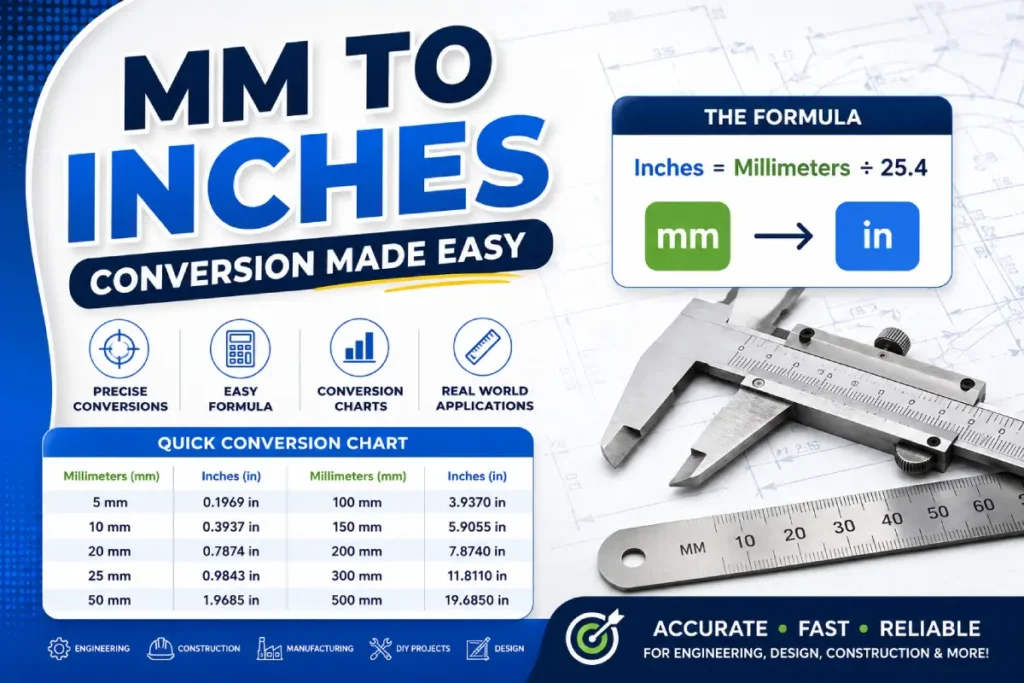
Converting millimeters (mm) to inches is a core requirement across engineering, precision manufacturing, construction, woodworking, automotive repair, and everyday DIY projects. Because modern workspaces handle a mix of both metric and imperial measurement systems, professionals and hobbyists must be able to switch between these units accurately.
Whether you are reading technical blueprints, selecting specialized drill bits, comparing product dimensions, or sourcing hardware fasteners, understanding how millimeters relate to inches will save you time, eliminate wasted materials, and prevent costly calculation mistakes.
Live MM to Inches Reference Calculator
Need an instant calculation for a custom dimension? Use our interactive tool below. Drag the slider or type your exact millimeter value to get both decimal and fractional inch readouts instantly.
What Are Millimeters and Inches?
While these units belong to completely separate measurement frameworks, they describe the exact same physical dimension: length.
- Millimeter (mm): A base unit of length in the metric system (SI). It represents exactly one-thousandth ($1/1000$) of a meter. Because it divides length into small, uniform increments based on powers of ten, it is the global standard for high-precision technical measurements.
- Inch (in or “): A traditional unit of length in the imperial and US customary measurement systems. It is deeply embedded in American infrastructure, dominating residential construction, home improvement, plumbing frameworks, and consumer hardware.
The Mathematical Relationship & Formula
To eliminate discrepancies between manufacturing standards across different countries, the international community established a strict mathematical baseline:
The International Standard: 1 inch is defined as exactly 25.4 millimeters.
Because this standard is fixed and universally adopted, conversions between metric and imperial components are perfectly repeatable.
The MM to Inches Conversion Formula
To change millimeters into inches manually, divide your millimeter measurement by the baseline factor of 25.4:
The Fast Alternative: Multiplication
If you are working with software or calculators that process multiplication faster, multiply your millimeter value by 0.0393701:
Alternative Multiplication Formula
Common MM to Inches Conversions (with Real-World Examples)
The dimensions below are the most common values encountered in mechanical blueprints, hardware sizing, and architectural layouts. We have mapped them to standard physical objects to give you immediate spatial context:
| Millimeters (mm) | Decimal Inches (in) | Common Real-World Hardware Equivalent |
| 5 mm | 0.1969 in | Standard flat-pack furniture shelf pins |
| 6 mm | 0.2362 in | Small paracord / structural pop rivets |
| 8 mm | 0.3150 in | Standard skateboard axle bearings (608 size) |
| 10 mm | 0.3937 in | The most common automotive socket wrench size |
| 12 mm | 0.4724 in | Medium structural anchor bolts |
| 16 mm | 0.6299 in | Heavy-duty industrial rebar diameter |
| 20 mm | 0.7874 in | Watch band width / conduit pipe fittings |
| 25 mm | 0.9843 in | Roughly equal to 1 inch (commonly used for plumbing pipes) |
| 50 mm | 1.9685 in | Standard camera lens focal length / 2-inch hitch balls |
| 100 mm | 3.9370 in | Standard computer cooling fan size (4-inch class) |
| 300 mm | 11.8110 in | Standard architectural drafting ruler length |
Fractional Inches Reference Chart
Because North American construction, carpentry, and machining tools use physical fractions marked on measuring tapes, you will often need to find the closest fractional equivalent rather than using raw decimals.
| Fractional Inch | Decimal Inch Equivalent | Exact Millimeter Equivalent |
| 1/8″ | 0.125 in | 3.175 mm |
| 1/4″ | 0.250 in | 6.350 mm |
| 3/8″ | 0.375 in | 9.525 mm |
| 1/2″ | 0.500 in | 12.700 mm |
| 5/8″ | 0.625 in | 15.875 mm |
| 3/4″ | 0.750 in | 19.050 mm |
| 1″ | 1.000 in | 25.400 mm |
How to Convert MM to Inches: Step-by-Step Examples
Let’s look at a few practical examples using our division formula (mm ÷ 25.4) to see how easy it is to calculate manually.
Formula Application Examples
Industry Applications: Who Uses This Conversion?
- Mechanical & Aerospace Engineering: Engineers routinely scale blueprints between metric raw materials and imperial manufacturing tools when working with international supply chains.
- Precision CNC Machining & 3D Printing: CAD design files natively generate dimensions in millimeters. However, machinists and fabricators often scale these objects to match imperial stock materials or tooling setups.
- Automotive Repair: Mechanics routinely bounce between domestic vehicles (which historically favored imperial fasteners) and imported vehicles (which use metric frameworks entirely).
- Carpentry & Construction: Builders frequently encounter imported building items like tiles, subflooring, or specialty hardware measured in millimeters, which must fit seamlessly into building frames built in inches.
How to Prevent Costly Conversion Errors
Small mathematical mistakes compound quickly over large scale structures. Use these rules of thumb to guarantee precision:
- Do Not Round Early: Keep your calculations at four decimal places ($0.0000$) throughout your equations. Only round your final number down to avoid compounding structural margins of error.
- Verify the Context (Clearance vs. Interference): When matching a metric bolt to an imperial drill bit, remember that a fraction is rarely a perfect match. Decide if you need an over-sized hole for clearance or a tight fit.
- Use Dedicated Pages: For specific hardware values, use targeted reference hubs to check verified fractions. You can check individual breakdowns on our indexing platform at MM to Inches Online.
Frequently Asked Questions
How many millimeters are in an inch?
There are exactly 25.4 millimeters in one inch. This conversion metric is internationally standardized for all manufacturing and trade applications.
Is 25 mm identical to 1 inch?
No. While 25 mm is a convenient shorthand estimate for field-work, it is slightly shorter than a true inch. 25 mm equates to 0.9843 inches. If you need an exact imperial inch, you must use 25.4 mm.
Why is 25.4 the designated standard conversion factor?
Before 1959, the US inch and the British inch differed by tiny fractions of a millimeter. The International Yard and Pound Agreement of 1959 officially standardized the inch as exactly 25.4 mm to ensure absolute consistency across scientific and defense industries globally.
Where is mm to inches conversion most commonly used?
It is commonly used in construction, engineering, machining, manufacturing, woodworking, automotive repair, and product design.
Are millimeters more precise than inches?
Millimeters provide finer resolution for small measurements and are commonly preferred in engineering and manufacturing.
Summary
The ability to translate millimeters to inches serves as a vital bridge between the two most dominant engineering frameworks on earth. By understanding the 25.4 division rule and tracking how decimals map onto tape-measure fractions, you can confidently navigate blueprints, purchase parts accurately, and executing DIY projects flawlessly.
Keep this guide bookmarked, or visit MM to Inches Online whenever you need a fast, accurate calculation on the fly!